Introduction
Strength training is one of the most effective ways to improve how you move, feel, and perform. But results don’t come from simply lifting weights. They come from progressing your training in a structured way over time.
This is where progressive overload comes in.
It’s the foundation of getting stronger, building muscle, and continuing to see results without burning out or stalling. When applied correctly, it gives your training direction and purpose.
Many people train hard, but without a clear progression. Workouts change too often, intensity is inconsistent, or increases happen too quickly. Over time, this makes it harder to build momentum or see steady progress. In worst cases, it can lead to regression or injury.
Key Takeaway: Progressive overload is not about doing more every workout. It is about increasing training stress gradually, in the right way, at the right time, so your body can adapt without unnecessary setbacks.
This guide will show you how to apply progressive overload in a practical, sustainable way so your training stays consistent, effective, and aligned with your goals.
Before you read on, grab these handy guides to help you with your training:
Contents:
- Start Here: How Heavy Should I Lift?
- How to Apply Progressive Overload Properly
- When You Have Limited Equipment
- How Progress Is Mathematically Measured
- How to Progress Without Adding Weight or Reps
- General Strength Training vs Goal-Specific Training
- Common Strength Training Missteps
- Soreness and Recovery
- Training On Good Days vs Low-Energy Days
- How Fast Do You Lose Strength and Muscle When You Stop Lifting?
- Combining Strength Training with Endurance Training
- Strength Training Myths
- Do Women Need Different Strength Programs?
- Do Older Adults Need Different Strength Programs?
Quick Terms Before You Start:
- Rep = one complete movement
- Set = a group of reps
- Rep range = the number of reps you are aiming for, such as 8–10 reps
- Load = the weight you are lifting
- Volume = the total amount of work completed, usually measured by sets, reps, and load
- Tonnage = reps × weight, used to estimate total load lifted
- Tempo = the speed of each part of a rep, such as lowering, lifting, or pausing
- Reps in reserve (RIR) = how many reps you could still do before failure
- Hypertrophy = an increase in muscle size
Start Here: How Heavy Should I Lift?
Your first session is not about pushing hard. It’s about setting the right starting point so you can progress without excessive soreness or setbacks. Most people start too heavy. That leads to poor movement, fatigue, and inconsistent training.
Your First Session (or Rebuilding)
If you are just starting out with little experience or rebuilding after an extended time off, use a weight that is lighter than you think you need. You should stay at this weight for several sessions, until the routine feels easy to complete. That allows you time to build a base foundation to work from and progress with lower risks.
If you have been off for 2-3 weeks, I suggest starting with 20-30% less weight than your last session. But, if you have been off for a month or more, then start at about ~50% less weight. The reason is because the longer you are off, the more strength losses you have and so you lose that base foundation. That’s the first thing to rebuild. It’s better to rebuild on the lighter side, build back your base, and then progress safely from there.
- Choose a weight that feels easy on the first session
- Focus on control and technique
- You should finish each set feeling like you could do 4–6 more reps
- All reps should feel smooth and controlled
- Keep sessions light for the first 2-3 weeks, or until it feels too easy
After the First Few Sessions
Once movements feel comfortable, easy and soreness is gone, you can begin training at the right intensity. Use RIR (Reps In Reserve) to gauge your effort. RIR means how many reps you could still do before you hit failure. You can begin to gradually add reps or load, depending on where you started.
- Gradually increase intensity at each session, working toward leaving 2–3 reps in reserve (RIR) at the end of each set
- This means you stop the set when you feel you could still do 2–3 more reps
- Sets should feel challenging, but not maximal
- Maintain good form throughout
- You can increase effort by adding reps or load, but NOT both at the same time
Quick Self-Check
Use this after each session to guide your load.
- First sessions in 1-2 weeks: could do 4–6 more reps → correct
- Ongoing training: gradually build that you could do 2–3 more reps → correct
- Could not do more reps → too heavy
- Could do many more reps easily → too light
What Not To Do
- Do not train to failure
- Do not test your max
- Do not choose weight based on past lifts
- Do not compare to others
Key Reminder: You are not trying to prove how strong you are in one workout. You are choosing a weight that allows you to progress consistently over time.
How to Apply Progressive Overload Properly
Progressive overload means gradually increasing the challenge of your workouts over time so your body continues to adapt. Your goal is to make small, controlled changes that you can repeat consistently.
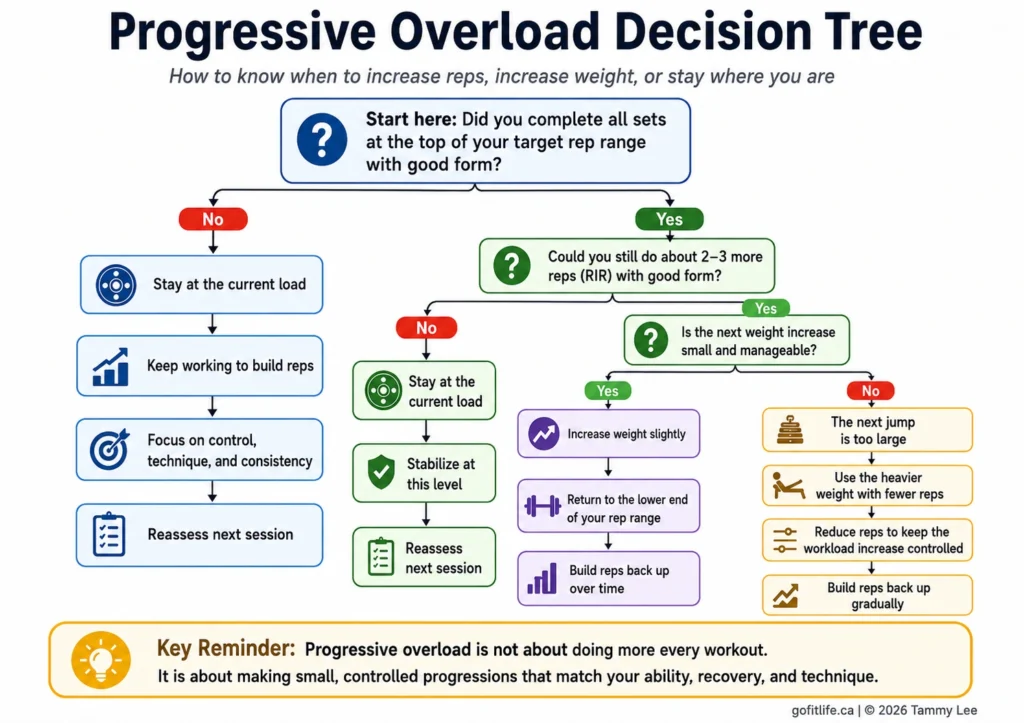
The Order of Progression
- First → increase reps within the rep range
- Then → increase weight once all sets reach the top of the range
- Sets only change if programmed
Which Set to Progress (and Why)
Start by progressing the last set first.
- The last set reflects your true working capacity due to fatigue
- Increasing it first keeps total workload increases controlled
Example (3 sets of 8–10 reps):
- Session 1: 8, 8, 8
- Session 2: 8, 8, 9
- Session 3: 8, 9, 10
- Session 4: 9, 10, 10
- Session 5: 10, 10, 10 → increase weight
When to Increase Weight
- All sets reach the top of the target rep range
- Form and technique remains consistent
- You can still perform 2–3 more reps
How Much Weight to Add
- Upper body: 2–5% increase
- Lower body: 5–10% max
- Use the smallest increase available, if unsure
How to Calculate Your Increase
Multiply your current weight by the percentage.
Example:
- Current weight: 20 lb
- 5% increase = 1 lb
- New target = 21 lb
When your equipment does not allow that level of precision, choose the closest available weight. For larger jumps, stay at your current weight longer and continue building reps within your target range. When adding more reps is no longer desirable, use the mathematical calculation below to adjust properly for the next available weight.
When You Have Limited Equipment
Limited weight availability is common in home gyms or smaller gyms. Maybe you only have a range of dumbbells that jumps in 5 lbs increments or barbells without smaller plates. The good news is, there’s a way to work with these limitations.
If the next weight is a large increase (example: 10 lb → 15 lb), you must adjust your reps to keep the increase of total load controlled.
How to Adjust Your Reps
A simple method is to reduce reps by ~30–50%. So if you were doing 10 reps with 10 lbs and you now want to use a 15 lbs weight, you could then do 5 or 7 reps without overshooting the workload too aggressively.
A more exact method is to use a mathematical calculation using total load.
Example:
- Current weight: 10 lb x 10 reps = 100 lb total load per set
- Target: increase weight by 5% = 105 lb total load per set
- New weight: 105 lb (target load) ÷ 15 lb (new weight) = 7 reps
So then you would move forward by using the 15 lb weight x 7 reps to get a 5% increase in total load per set.
Whether you are using the simple or mathematical method, first work to stabilize lifts at the new weight, and then build your reps back up from there.
Example with new weight:
- Session 1: 15 lb → 5–7 reps
- Session 2: 15 lb → 7–8 reps
- Session 3: 15 lb → 8–9 reps
- Continue building back to your desired rep range
How Progress Is Mathematically Measured
Total tonnage is the total amount of weight lifted across sets, exercises, workouts, or weeks. This is useful to track because it helps you monitor how much total work you are accumulating over time and avoid sudden spikes in workload.
- Individual set tonnage = reps × weight
- Specific exercise tonnage = total of all sets
- Workout tonnage = total of all exercises
- Weekly tonnage = total across all sessions
Here’s an example of total tonnage, assuming there are 4 exercises in a routine, all performed as 3 × 10 @ 10 lb:
- Per set: 10 reps × 10 lb = 100 lb
- Per exercise: 100 lb × 3 = 300 lb
- 4 exercises: 300 lb × 4 = 1200 lb per session
- Weekly total (3 sessions): 1200 lb × 3 = 3600 lb per week
‼️ Your body responds to the overall training stimulus, not just the weight on one set. This is one of the most important reasons why logging your lifts is so important.
Why Tracking Tonnage Matters
Tracking total tonnage gives you a clear picture of how much work you’re actually accumulating across your training. When you can see and adjust that workload, you’re better able to:
- Keep soreness more predictable from session to session
- Recover more effectively between workouts
- Build progress through steady increases in total work
- Avoid sudden spikes in load and train more consistently over time
Tracking tonnage gives you one useful way to estimate the total work you complete in a workout. By monitoring it over time, you can apply progressive overload, avoid doing too little or too much, and adjust your training based on clear data instead of guesswork.
Why Consistency Matters
Consistency is what allows your body to adapt and learn. When training is applied regularly and builds at a manageable pace, your body can refine movement patterns, improve coordination, and develop strength more efficiently over time.
What this looks like:
- Repeating key movements often enough to improve technique
- Gradually increasing difficulty without large swings in effort
- Training that feels challenging but manageable from session to session
- A routine that supports regular, uninterrupted training
This approach helps you:
- Improve movement quality and efficiency
- Reinforce strength gains through repetition and practice
- Build confidence in your training
- Stay on track without frequent interruptions or resets
This is similar to skill development in any activity where progress comes from consistent practice, not random effort.
What Consistent Progress Can Look Like
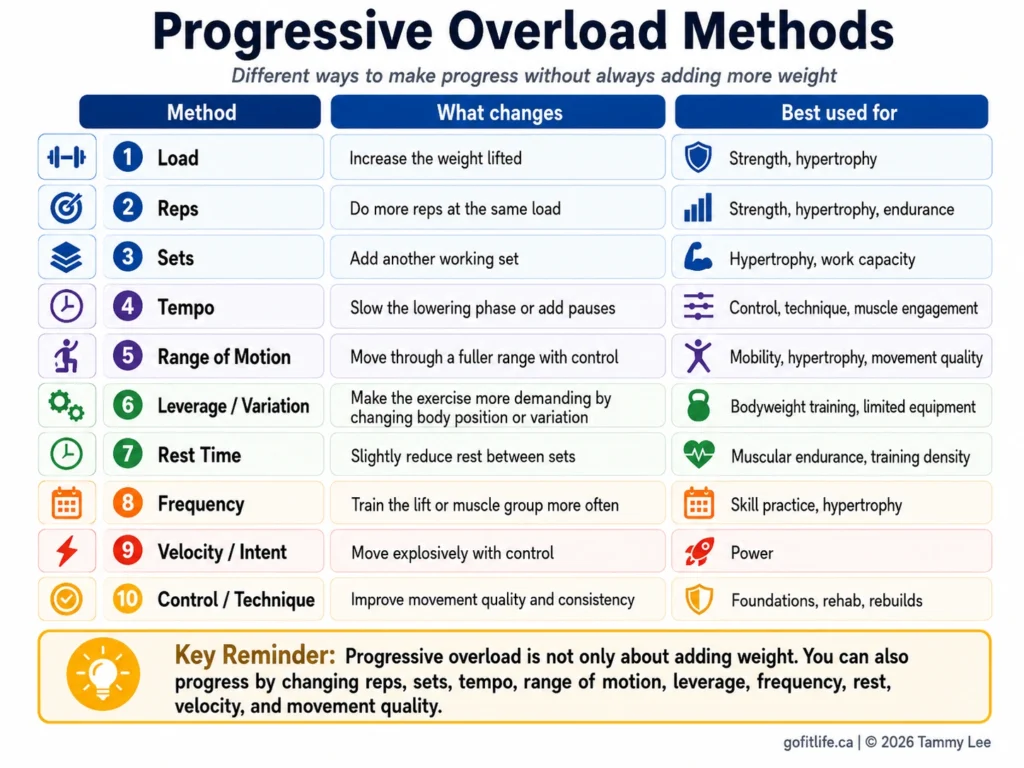
Consistent progress doesn’t rely on a single variable. It can be achieved in multiple ways, depending on your training goal:
- Increasing weight lifted
- Increasing reps at the same weight
- Adding more sets
- Improving technique to lift more efficiently
- Increasing time under tension
- Slightly reducing rest time between sets, when appropriate for the goal
- Increasing training frequency for a lift or muscle group
- Increasing speed of a lift
How to Progress Without Adding Weight or Reps
You can increase difficulty by changing how the exercise is performed. This is especially helpful when you are limited in equipment, working at the top of your rep range, or you are traveling and want to maintain your effort level. Here are some methods to get more out of your training without adding weight or reps.
Change Angle
Changing the angle changes how much load you are working against or how the muscle is challenged.
Example (push-ups):
- Wall push-up → easiest (more upright, less body weight)
- Incline push-up → moderate
- Floor push-up → hardest (more body weight)
Example (bicep curls):
- Standing curl → baseline
- Seated incline curl (arms slightly behind body) → more challenging due to stretch and angle
Change Leverage
Changing leverage changes how much of your body you are lifting or how stable you are.
Example (push-ups):
- Knee push-up → shorter lever, easier
- Toe push-up → longer lever, harder
Example (squats):
- Regular squat (both feet on ground) → more stable
- Split squat (one foot forward, one back) → more demanding
- Rear-foot elevated split squat → most demanding
Change Grip or Hand Position
Changing grip or your hand position changes which muscles assist and how difficult the movement feels.
Example (pull-ups):
- Chin-up (palms facing you) → often easier
- Pull-up (palms facing away) → often more challenging
Example (push-ups):
- Hands under shoulders → baseline
- Hands closer together → more demanding for many people
Additional Ways to Progress Without Adding Weight
- Slow down the lowering phase (eccentric)
- Lift with intent on the upward phase (concentric)
- Add pauses during the movement
- Improve control and technique
- Slightly reduce rest periods
Key Reminder: Progress should be gradual and controlled. You are building your total workload over time, not trying to do more in a single workout.
General Strength Training vs Goal-Specific Training
Most people are doing general strength training, and that’s great. When done consistently and progressed using the methods outlined above, this improves multiple qualities at the same time:
- Strength (ability to produce force)
- Muscle (increase in muscle size)
- Muscular endurance (ability to perform repeated efforts)
- Power (ability to produce force quickly)
- Mobility (ability to move through a full range of motion under control)
- Stability (ability to control joints and maintain position during movement)
- Bone and joint health (improving bone density and joint resilience under load)
Many of these qualities can improve together when you train with good technique, control, and full range of motion.
When General Strength Training Is Enough
- You want to feel stronger and more capable
- You want to build muscle gradually
- You want to improve overall movement quality
- You are not training for a specific performance goal
With consistent strength training and proper progression, many of these areas can improve over time.
When Training Becomes Goal-Specific
If you want to maximize one area, your training needs to shift. This is the Principle of Specificity, also known as specific adaptations to imposed demands (SAID). Here, your training becomes more specific and so the body adapts to the specific demands you impose. This is especially useful when you want to do targeted training for personal goals, such as the ones listed below.
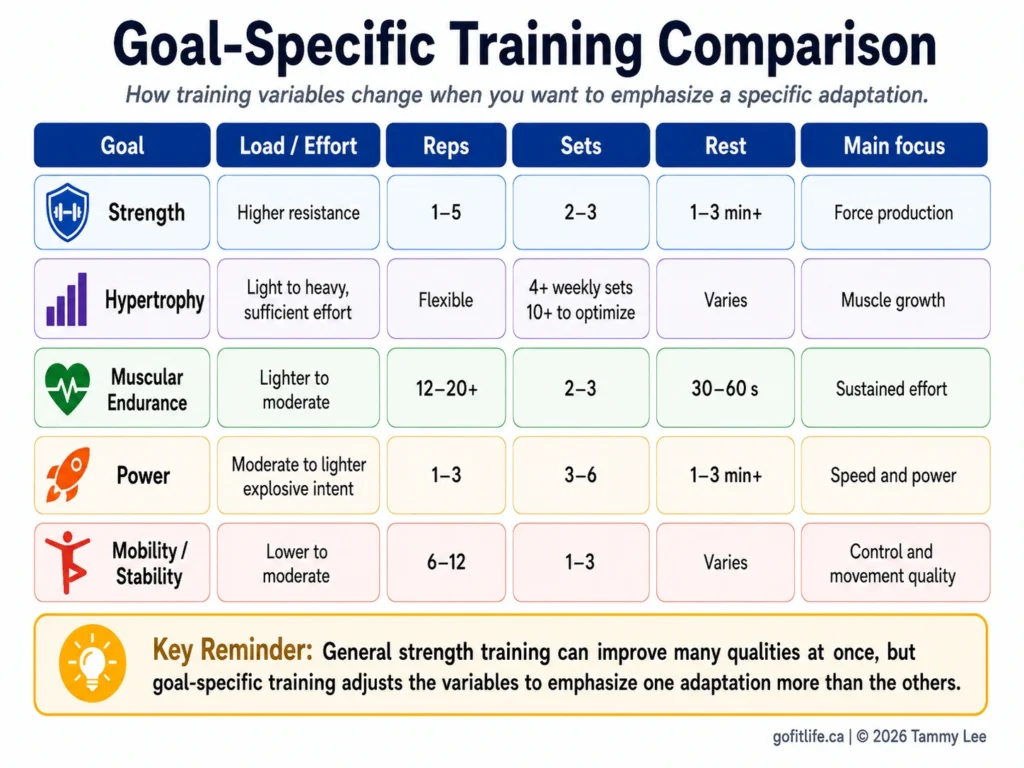
Strength Focus
- Higher resistance with an emphasis on force production
- Lower reps, often around 1–5 reps per set
- Approximately 2–3 sets, depending on experience, recovery, and the training goal
- Longer rest between sets, often around 1–3 minutes or more for heavier lifts
- Maintain strong technique and avoid grinding every set to failure
Hypertrophy Focus
- Muscle can be built with light, moderate, or heavy resistance, including bands and bodyweight, provided sets are performed with sufficient effort.
- Reps can be higher or lower, so choose a rep range you enjoy and can perform consistently.
- Aim for at least 4 total sets per week per muscle group as a minimum.
- To further optimize growth, aim for 10+ total sets per muscle group per week.
- Focus on full range of motion and good muscle engagement.
- Hypertrophy is driven by sufficient effort, total volume, and consistency over time.
- Use controlled reps, especially during the lowering phase.
- Rest between sets and tempo can vary.
Muscular Endurance Focus
- Lighter to moderate resistance with an emphasis on repeated, sustained effort
- Higher rep ranges, often around 12–20+ reps per set
- Approximately 2–3 sets, depending on the exercise, goal, and recovery
- Shorter rest between sets, often around 30–60 seconds
- Maintain control and technique as fatigue builds
Power Focus
- Moderate to lighter resistance performed with controlled technique, explosive intent, and high movement velocity
- Lower reps per set, often around 1–3 reps
- Higher number of sets, often around 3–6 sets depending on the exercise, goal, and recovery
- Full recovery between sets, often 1–3 minutes or more depending on load, velocity, and movement quality
- Stop the set if speed, control, or coordination drops noticeably
Mobility or Stability Focus
This type of training is often used in rehab, corrective exercise, foundational strength phases, return-to-training phases, or when movement quality, joint control, range of motion, balance, or positioning is limiting how well you can train.
- Mobility: the ability to actively move through a full range of motion with control
- Stability: the ability to control joint position and movement while producing, transferring, or resisting force
- Targeted exercises for specific limitations in range of motion, joint control, positioning, or movement quality
- Lower to moderate effort, depending on the exercise and goal
- Controlled reps, often around 6–12 reps per side or movement
- Approximately 1–3 sets, depending on the limitation, fatigue, and where it fits in the program
- Slower tempo, pauses, or end-range holds may be used to improve control
- Load can be added gradually once movement quality is consistent.
Key Differences
General strength training = balanced progress across multiple qualities.
Goal-specific training = intentional focus on one area.
If you are unsure, stay with general strength training and focus on doing it consistently with structured progression over time. If you want to learn more about goal-specific training, post your questions in the comments section below.
Common Strength Training Missteps
These are the most common reasons people feel stuck, sore, or not progressing.
- Increasing weight too quickly
- Changing multiple variables at once
- Adding extra sets or exercises randomly
- Inconsistent weekly training
- Training based on how you feel instead of a plan
- Treating every workout like a test
- Following random workouts without tracking progress
Key Reminder: If your training feels inconsistent, your results will be inconsistent.
Soreness and Recovery
Many people believe that soreness means a workout was effective. This idea stems from old-school theories preached by trainers around the globe. We have learned that this is not true.
Muscle soreness comes from small amounts of muscle damage and inflammation as your body adapts to training. It is not a reliable sign of progress, and chasing it can push you to train too hard or too often without enough recovery. This can reduce performance, disrupt consistency, and increase the risk of injury.
Feeling sore is not inherently bad, it may happen when you start a new type of exercise or change things up. However, it should subside as you progress and become fitter.
Soreness (DOMS) is a response to:
- New exercises
- Increased workload
- Changes in training
Why Some People Feel Sore Frequently
- Large spikes in workload
- Inconsistent training
- Adding too much too soon
This is often the result of poor progression. The good news is that it can be corrected.
Can You Train When Feeling Sore?
If you feel sore, you do not have to stop training as it depends on individual circumstances. Use the guide below to assess where you are at and then decide. It’s okay to take an extra rest day. Rest is where adaptations occur, giving your body time to repair and restore.
- Mild soreness → train normally but stay at maintenance
- Moderate soreness → reduce load, reps or sets slightly
- Severe soreness → take the day off for muscle repair and restoration
Key Reminder: The goal is not to feel sore, but to feel strong. The goal is to train consistently and recover well enough to progress.
Training On Good Days vs Low-Energy Days
Your training should follow a logical and practical plan, and not driven by mood or energy on a given day. I have learned through my own mistakes that showing up feeling good doesn’t mean I should make big leaps in my training that day. I have also learned that if I’m exhausted, it will do me better to take a recovery day.
If You Feel Strong
- Stick to your planned workout
- You may increase slightly within your progression rules
- Do not make aggressive or high-risk jumps in weight or volume
Example:
- If you planned to increase reps → do that
- If you are at the top of your rep range → increase weight as planned
- Be patient throughout the workout and note you felt at the end
If You Feel Tired or Low Energy
- If feeling exhausted or sick, skip the workout and rest
- If feeling unmotivated, complete the workout in maintenance mode
- If feeling weak but ready, reduce volume (deloading is okay)
- If you are feeling unfocused and sloppy, go slow at reduced load or take the day off
The problem here is that some people think skipping a workout automatically means failing or losing fitness. This is not true. Science shows us that chronic fatigue decreases performance and increases injury risks. Science also shows us that it is during rest and recovery where we adapt the best. Take the rest if you have warning signs – it is NOT a failure!
If You Feel Sore or Tight
- Train, but do a longer warm-up
- Stay within a comfortable range of motion
- Maintain loads from last session or reduce load slightly if movement feels restricted
- Move slowly, do fewer reps, or take longer breaks in between sets with light stretching
Key Reminder: Progress comes from multiple sessions and consistent training over time, not from individual “good” or “bad” days. Stick to the plan and auto-regulate as needed.
How Fast Do You Lose Strength and Muscle When You Stop Lifting?
One of the biggest fears people have when taking time away from the gym is losing all their progress. Fortunately, strength and muscle loss happen much more slowly than most people think.
According to Brad Schoenfeld and current detraining research, measurable strength losses are usually minimal during the first 1–2 weeks away from resistance training. In many cases, the earliest changes are neurological rather than actual muscle loss.
Here’s a general timeline of what research shows can happen when resistance training stops completely:
- 1 week off: little to no measurable strength loss (roughly 0–3%)
- 2 weeks off: small decreases may begin (around 3–7%)
- 1 month off: more noticeable declines can occur (approximately 5–15%)
- 2–3 months off: larger reductions in maximal strength and power become more apparent
Muscle size is typically retained longer than maximal strength. During the first couple of weeks away from training, most people lose very little actual muscle tissue. Feeling “smaller” or flatter is often related to reduced muscle glycogen, hydration, and training pump rather than true muscle loss.
More significant muscle loss is more likely to occur after several weeks of complete inactivity, especially when combined with lower protein intake, reduced calorie intake, and less daily movement overall.
Advanced lifters may notice strength declines slightly faster than beginners because they have developed greater neuromuscular adaptations over time. However, trained individuals also regain lost strength and muscle more quickly due to muscle memory.
The key takeaway: missing a week or two of training is not catastrophic. You are unlikely to lose meaningful muscle mass that quickly, and any small reductions in strength usually return rapidly once consistent training resumes.
In fact, even maintaining just 1–2 strength sessions per week can dramatically reduce detraining effects and help preserve both strength and muscle mass.
Returning From Short Breaks
Time away from training is normal, such as illness, going on vacation, or taking time off for other reasons. The goal is to return safely and rebuild quickly, not to pick up where you left off in the last session.
What to Expect
- Strength and performance may feel lower
- Movements may feel harder or less coordinated
- Mild soreness is more likely afterwards
- Or, you may feel super strong with the extra rest
This is temporary. Allow the first session to feel things out.
How to Restart
- Reduce load by ~10–20% for your first few sessions
- Start at the lower end of your rep range
- Focus on technique and control
How to Progress Back
- Resume your normal progression rules
- Build back gradually over a few sessions
- Do not rush increases in weight or volume
What Not To Do
- Do not try to match your previous numbers immediately
- Do not increase weight and volume at the same time
- Do not “make up for lost time”
Key Reminder: You don’t lose progress as quickly as you think. A controlled return will get you back faster than pushing too hard too soon. And the more consistent you are with strength work, the faster your body responds. Neuromuscular memory is a beautiful thing!
Combining Strength Training with Endurance Training
Most endurance athletes do not skip strength training only because of time. They skip it because they:
- Do not know what exercises to do
- Do not understand how it improves performance
- Are unsure how to structure it
- Worry it will interfere with their sport
- Do not know when to include it in their training cycle
Why Strength Training Matters for Endurance
Strength training can support endurance performance by improving:
- Force production: stronger stride or pedal stroke
- Movement economy: using less energy at a given pace
- Durability: tolerance to repeated training load over time
- Injury resistance: greater capacity to handle repetitive stress
A basic movement like a squat improves:
- Lower body strength
- Stability
- Force transfer
All of which directly support running and cycling.
The Real Problem
Most endurance athletes are:
- Following endurance plans without strength training
- Doing random strength workouts without progression
- Not aligning strength training with their annual periodization plan
This leads to:
- Poor carryover
- Increased fatigue
- No clear progress
- Performance interference in their main sport
How to Apply Strength Training Across Your Training Year
Strength training should match your training phase. For endurance athletes, we typically have an off-season, pre-season, base period, competitive build, race weeks, and a few others in between (prep period, deep recovery, transitions)
Off-season:
- Highest opportunity for strength development
- Focus on:
- Correctives and imbalances
- Mobility and stability
- Building foundational strength and muscle
- Higher frequency (more sessions per week)
- Can follow a structured 6–8 week foundational program
This is where you build the capacity to handle more training later.
Base phase:
- Continue building strength
- Heavier resistance or higher effort
- Structured progression
- Reinforce movement quality
Build phase:
- Maintain strength
- Introduce more power-focused work
- Shorter, more efficient sessions
Race phase:
- Maintain intensity but reduce volume during taper
- Omit sessions during race week
- Deload post-race week
What to Avoid
- Adding high-volume strength training during peak endurance training
- Starting strength training late in a training cycle, especially during build phase
- Doing random strength workouts without structure
- Doing strength work right before or after a key training session for your sport (space them 4 to 6 hours apart)
Key Reminder: Strength training should support your endurance training, not compete with it. When applied correctly, it improves performance without interfering with your sport.
And if you are unsure why strength training matters for endurance sports performance, read this next: Why Endurance Athletes Need Resistance Training.
How to Know If You’re Progressing Properly
Progress should feel small from workout to workout. The number one thing you should be doing is logging all your lifts and sessions. If you aren’t assessing, you are guessing. In order to assess, you have to track.
Signs You’re on Track
- You are repeating the same workouts consistently
- You are making small increases over time
- Your performance is slowly improving
- Your workouts feel challenging but manageable
- You are recovering well between sessions
Signs Something Is Off
- Your workouts feel very different week to week
- You are constantly sore or fatigued
- You are making large jumps in weight or volume
- You are not sure what you did last session
- You are changing workouts frequently
Key Reminder: Progress is not about one workout. It is about what happens over weeks and months of consistent training.
Strength Training Myths
These are the most common beliefs that lead to poor training decisions.
You Must Lift Heavy to Build Muscle
- Muscle can be built with light, moderate, or heavy resistance
- What matters is effort, volume, and progression over time
Feeling Sore Means You Made Progress
- Soreness is a response to change, not a requirement
- Consistent training, not soreness, drives results
Train to Failure to Build Strength or Muscle
- Most sets should stop before failure
- Training to failure too often reduces recovery and consistency
Variety Is Required to Keep Improving
- Repeating movements allows progress
- Too much variation reduces consistency and results
More Is Always Better
- More volume is not better if it is inconsistent
- Progress comes from controlled, repeatable increases, not excess
You Should Always Increase Something Every Workout
- Progress does not need to happen every session
- Holding the same weight or reps is part of progression
Key Reminder: Most problems come from doing too much, too fast, or too randomly.
Do Women Need Different Strength Programs?
For most women, strength training does not need to be completely different from men’s strength training. The same core principles apply: progressive overload, consistency, appropriate effort, recovery, good technique, and training that matches the person’s goals.
There is also no consistent evidence that most women need mandatory training changes based on menstrual cycle phases. However, symptoms, recovery, energy levels, sleep, stress, and overall training load can vary, and training can be auto-regulated as needed.
This distinction matters because individualized training adjustments are useful, but they are not the same as needing completely different strength training rules.
This also applies through perimenopause and menopause. The principles of strength training remain the same, but programming should still account for the individual’s goals, symptoms, training history, recovery capacity, and current fitness level.
Key Reminder: Women do not need a completely separate set of strength training rules. They need well-designed programming that applies sound strength training principles to the individual.
Do Older Adults Need Different Strength Programs?
For most older adults, strength training does not need to follow a completely different set of rules. The same core principles apply: progressive overload, consistency, appropriate effort, recovery, good technique, and training that matches the person’s goals and current ability.
What may change with age is the starting point, rate of progression, exercise selection, recovery needs, and how much support or modification is needed. Progress may also look different. It may include better balance, improved confidence, greater range of motion, more control, easier daily movement, more reps at the same load, or gradually adding resistance over time.
This distinction matters because older adults are often underloaded or treated as too fragile to progress. Strength training should still be progressive, but it should be progressed intelligently and matched to the individual.
So Does Progressive Overload Apply at Every Age?
Yes. Progressive overload can apply across the lifespan, including youth, adults, and older adults. What changes is how it is applied. For youth, the emphasis should be on movement skill, coordination, confidence, technique, and age-appropriate progression. For adults and older adults, the emphasis may shift toward strength, muscle, bone health, performance, function, or maintaining independence.
Key Reminder: Older adults do not need watered-down strength training. They need well-designed programming that applies sound strength training principles at the right starting point, with the right progression, for the individual.
Conclusion
Strength training does not need to be complicated. It needs to be consistent, structured, and progressive. Most people do not struggle because they are not working hard enough.
They struggle because they are doing too much too soon, changing things too often, not tracking their training, or progressing in ways their body is not ready to handle.
Progressive overload gives your training direction. When you apply it properly, your workouts become more predictable, your recovery becomes easier to manage, and your results become more consistent over time.
The goal is not to do more every workout. The goal is to make small, controlled improvements that match your current ability, recovery, training history, and goals.
Whether you are building strength, muscle, endurance, power, movement quality, or long-term function, progress comes from repeating the right work consistently and adjusting it gradually over time.
I hope you found this guide helpful. If you have questions or comments, please feel free to post them below.
Sources:
American College of Sports Medicine (2026). Resistance Training Prescription for Muscle Function, Hypertrophy, and Physical Performance in Healthy Adults. https://journals.lww.com/acsm-msse/fulltext/2026/04000/american_college_of_sports_medicine_position.21.aspx
Encarnação, I. G. A., Viana, R. B., Soares, S. R. S., Freitas, E. D. S., de Lira, C. A. B., & Ferreira-Junior, J. B. (2022). Effects of detraining on muscle strength and hypertrophy induced by resistance training: A systematic review. Muscles, 1(1), 1–15. https://doi.org/10.3390/muscles1010001
Mujika, I., Padilla, S. Detraining: Loss of Training-Induced Physiological and Performance Adaptations. Part I. Sports Med 30, 79–87 (2000). https://doi.org/10.2165/00007256-200030020-00002
Llanos-Lagos, C., Ramirez-Campillo, R., Moran, J., & Sáez de Villarreal, E. (2024). Effect of strength training programs in middle- and long-distance runners’ economy at different running speeds: A systematic review with meta-analysis. Sports Medicine, 54(5), 1363–1385. https://doi.org/10.1007/s40279-023-01978-y
Llanos-Lagos, C., Ramirez-Campillo, R., & Sáez de Villarreal, E. (2026). Heavy strength training effects on physiological determinants of endurance cyclist performance: A systematic review with meta-analysis. European Journal of Applied Physiology, 126(1), 193–222. https://doi.org/10.1007/s00421-025-05883-2
Colenso-Semple, L. M., D’Souza, A. C., Elliott-Sale, K. J., & Phillips, S. M. (2023). Current evidence shows no influence of women’s menstrual cycle phase on acute strength performance or adaptations to resistance exercise training. Frontiers in Sports and Active Living, 5, 1054542. https://doi.org/10.3389/fspor.2023.1054542
D’Souza, A. C., Colenso-Semple, L. M., Elliott-Sale, K. J., Tang, J. E., & Phillips, S. M. (2026). Menstrual cycle phase does not influence training-induced muscle hypertrophy or strength: A randomized controlled trial. Medicine & Science in Sports & Exercise. https://doi.org/10.1249/MSS.0000000000004031
Radaelli, R., Fleck, S. J., Cadore, E. L., Pinto, R. S., & Bottaro, M. (2025). Effects of resistance training volume on physical function, muscle strength, lean mass, and muscle size in healthy older adults: A systematic review with meta-analysis. Sports Medicine. https://doi.org/10.1007/s40279-024-02166-8